
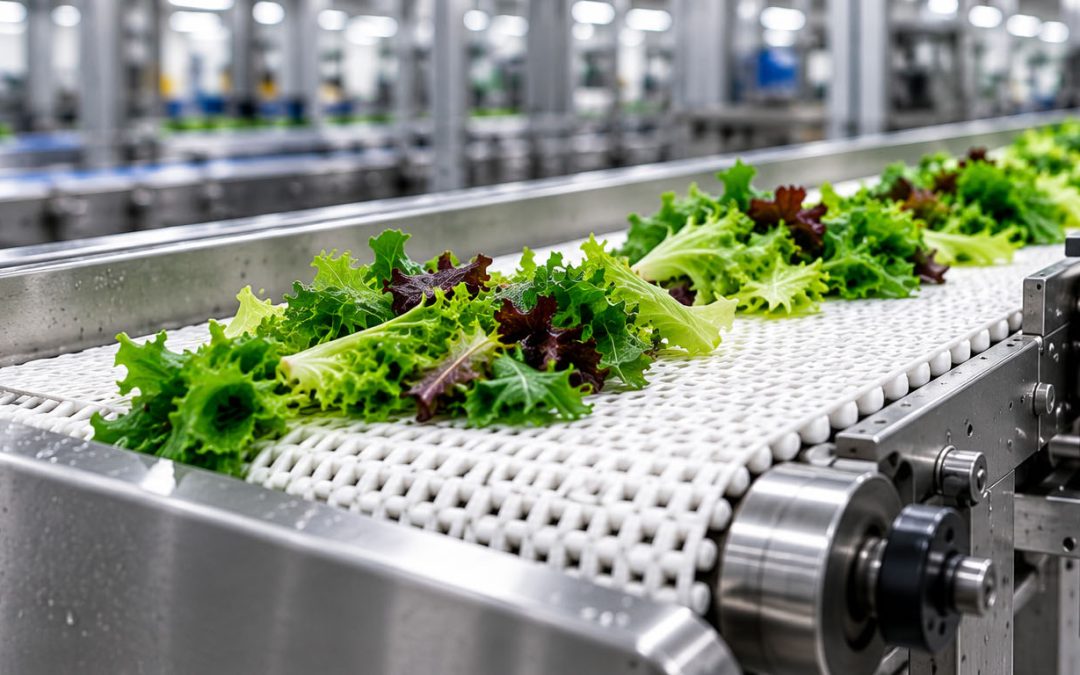
Conveyor belts are essential in food processing, moving ingredients and products efficiently between production stages.
The right conveyor belt improves hygiene, product quality, efficiency, and reliability for all types of food, from fresh produce to packaged goods.
Food processing poses unique challenges, including direct food contact, wet or oily conditions, frequent cleaning, and temperature changes.
Choosing the right belt material is essential.
Why Conveyor Belt Selection Matters in Food Processing
A conveyor belt in a food production environment does much more than simply move products from one location to another.
Depending on the process, the belt may need to withstand:
- Direct food contact
- Oils, fats and moisture
- Regular wash-down and sanitation
- Cleaning chemicals
- Hot or frozen products
- Cutting and abrasion
- Sticky ingredients
- Small product particles
- Frequent starts and stops
- Continuous high-speed production
At the same time, the belt must provide reliable tracking and consistent product handling while being straightforward to clean and maintain.
Selecting a belt specifically suited to these conditions can help reduce downtime, improve hygiene and extend operating life.
1. Hygiene and Cleanability
Hygiene is one of the most important considerations when selecting belting for food processing.
Where a belt comes into direct contact with food, its surface and construction should be appropriate for the product and cleaning regime.
Smooth, non-porous surfaces can make it easier to remove food residue, while carefully designed belt constructions can reduce areas where contamination might accumulate.
The entire conveyor system should also be considered. Belt supports, guides, sidewalls, cleats and joints can all influence how easily the equipment can be cleaned.
For applications involving frequent wash-down, selecting a belt capable of tolerating moisture and the specified cleaning chemicals is particularly important.
2. Food-Contact Compliance
Where conveyor belts come into direct contact with food, suitable food-contact compliant materials should be selected for the market and application concerned.
Depending on where equipment is being operated, relevant requirements may include UK, EU, FDA or other applicable food-contact standards.
It is important to check the specification of the specific belt grade, rather than assuming that every belt manufactured from a particular type of material is automatically suitable for direct food contact.
Our team can help identify suitable belt options based on your process and compliance requirements.
3. PU and TPU Conveyor Belts
Polyurethane (PU/TPU) conveyor belts are widely used throughout food processing because appropriate grades combine good mechanical performance with excellent cleanability.
PU belts can provide good resistance to oils, fats, abrasion and cutting while remaining flexible enough for many conveyor configurations.
They are commonly used for applications including:
- Meat and poultry processing
- Fish and seafood
- Bakery production
- Confectionery
- Dairy processing
- Fruit and vegetables
- Prepared foods
- Packaging
Smooth PU surfaces are particularly useful where easy cleaning and controlled product release are required.
Different surface finishes, thicknesses and constructions are available depending on the product and conveyor.
4. PVC Conveyor Belts
PVC conveyor belting provides a versatile and cost-effective solution for many food-related applications, particularly where direct contact conditions and hygiene requirements permit its use.
Suitable food-grade PVC belts can be used for dry food products, packaging and general product handling.
They are available with numerous surface patterns and finishes, allowing the coefficient of friction to be matched to the application.
PVC can be an effective solution for applications such as:
- Dry food handling
- Packaged products
- Boxes and cartons
- Secondary packaging
- General transfer conveyors
For applications involving significant quantities of oils, fats or aggressive cleaning, PU or another specialist material may offer better performance.
5. Modular Plastic Belting
Modular plastic conveyor belts are constructed from individual interlocking plastic modules driven by sprockets.
They are particularly useful in food processing because they can be supplied in open-grid configurations that allow water, debris and air to pass through the belt.
This can make them suitable for washing, cooling, draining and other processes where an open conveyor surface is beneficial.
Modular belts can also accommodate conveyor layouts involving curves, inclines and other configurations that may be difficult to achieve with conventional flat belting.
Another advantage is maintenance. Individual damaged modules can often be replaced without replacing the complete belt.
6. PTFE-Coated Belting
PTFE-coated conveyor belts provide excellent non-stick and release properties combined with resistance to elevated temperatures and many chemicals.
They are particularly useful where products are sticky or where heat forms part of the production process.
Typical applications include:
- Bakery equipment
- Cooking and drying processes
- Heat sealing
- Food release applications
- Confectionery
- Packaging machinery
PTFE-coated glass fabrics can be supplied in solid or open-mesh constructions depending on whether airflow is required through the conveyor.
7. Temperature Is an Important Consideration
Food processing can involve substantial temperature variations.
A belt may be expected to transport products from a freezer, through ambient production and into a heating, baking or drying process.
Different belt materials have very different temperature capabilities.
The operating temperature should therefore be established before selecting the belt. It is also important to consider whether the quoted temperature relates to the product, surrounding air or belt surface itself.
Temperature changes can affect belt flexibility, dimensional stability and service life.
8. Oils, Fats and Chemicals
Many food products naturally contain oils and fats, while cleaning processes introduce detergents and sanitation chemicals.
These substances can affect conveyor belt materials differently.
A belt that performs well in a dry bakery environment, for example, may not necessarily be suitable for conveying oily meat or fried products.
When specifying a belt, it is helpful to identify both the food products and cleaning chemicals that are likely to come into contact with it.
This allows the belt material to be selected with the appropriate chemical and oil resistance.
9. Surface Finish and Product Handling
The surface of the belt directly affects how the product behaves on the conveyor.
A smooth surface may provide good release and straightforward cleaning, while a textured surface can increase grip.
For inclined conveyors, additional features may be required.
These can include:
Cleats to prevent products from sliding backwards.
Sidewalls to help contain loose products.
Guides and tracking profiles to assist belt positioning.
The objective is to achieve sufficient grip and control without damaging delicate food products.
10. Open Mesh Belts for Airflow and Drainage
Some food processing applications require air or liquid to pass through the conveyor.
Open mesh belts can be particularly useful for:
- Washing
- Draining
- Cooling
- Freezing
- Drying
- Baking
- Air circulation
The appropriate material depends heavily on temperature and operating conditions.
Modular plastic belts may be suitable for washing and drainage, while PTFE-coated mesh or metal mesh constructions can be considered for higher-temperature processes.
11. Belt Joints and Splices
The joint is an important part of any food conveyor belt.
Different belt materials can use different joining techniques, including finger splices, overlap joints, mechanical fasteners and endless constructions.
For hygienic applications, the joint should ideally provide a consistent surface and minimise areas where food particles can become trapped.
Joint selection should also take account of pulley diameter, belt tension, cleaning requirements and the need for rapid belt replacement.
12. Reducing Downtime and Maintenance Costs
A belt that is inexpensive to purchase is not necessarily the most economical belt to operate.
Repeated belt failures, tracking problems or premature wear can result in:
- Lost production
- Additional maintenance
- Increased labour costs
- Product waste
- Cleaning delays
- Frequent replacement costs
Selecting a belt specifically for the application can therefore provide significant long-term savings.
When comparing options, consider the total cost of ownership, rather than the initial belt price alone.
Choosing the Right Food Conveyor Belt
There is no single conveyor belt suitable for every food processing application.
The correct solution depends on several factors, including the product being conveyed, whether direct food contact is involved, temperature, moisture, oils and fats, cleaning procedures, conveyor speed and configuration.
For many applications, the choice may be between PU/TPU, PVC, modular plastic, PTFE-coated or specialist belting, with different surface finishes and constructions available within each category.
Taking the time to correctly specify the belt can help deliver better hygiene, reliable product handling, longer service life and reduced production downtime.
Food Processing Belting from Inert Belting & Materials
At Inert Belting & Materials Ltd, we can help identify conveyor belting for a wide variety of food manufacturing and processing applications.
Our range includes PU and PVC process belts, modular belting, PTFE-coated belts and materials, mesh belting, specialist tapes and customised belt constructions.
Need Help Selecting a Food Conveyor Belt?
Contact our Technical Sales Team with details of your application, including the food product, conveyor dimensions, operating temperature, cleaning regime and current belt specification.
Where required, we can work with you to identify a suitable belt construction for your particular process.