
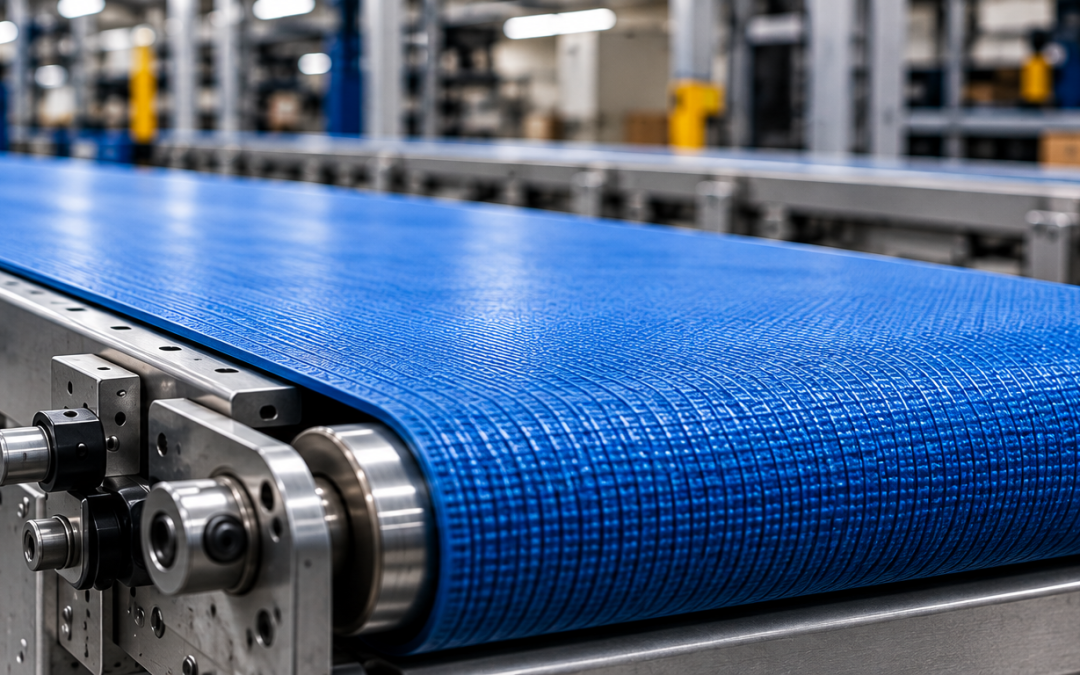
Choosing the correct conveyor belt can have a significant impact on the efficiency, reliability and operating cost of your production process.
With a wide range of belt materials, constructions, surface finishes and specialist options available, selecting a belt should involve more than simply matching its dimensions to the conveyor. The product being conveyed, operating environment, speed, temperature, hygiene requirements and conveyor design all need to be considered.
This guide explains how to pick the best conveyor belt for your needs.
- Start with the Product Being Conveyed
The first consideration should always be what the conveyor is actually handling. Different products place very different demands on a belt. Lightweight packaging may only require a simple PVC belt, while abrasive, oily, sticky, hot or delicate products can require a much more specialised solution. Consider factors such as product weight, size and shape, whether it is sharp or abrasive, whether oils or moisture are present, and whether the surface is delicate or easily marked. For food products, hygiene, cleanability and food-contact requirements become particularly important. Understanding the product is the first step towards narrowing down the available belt options.
- Consider the Operating Environment
The conditions surrounding the conveyor can be just as important as the product itself.
Temperature
Standard conveyor belts are designed to operate within defined temperature ranges. Applications involving ovens, dryers, freezers or heated products may require specialist materials. For example, PTFE-coated materials, silicone and metal mesh belts can provide solutions for elevated-temperature applications, while specially formulated materials are available for low-temperature and freezer environments.
Oils and Chemicals
Exposure to oils, fats, cleaning chemicals or solvents can cause some belt materials to swell, soften or deteriorate.Where chemical exposure is expected, the belt material and cover compound should be selected specifically for compatibility with those substances.
Moisture and Wash-Down
Food processing and other hygienic environments frequently involve regular washing and sanitation.
PU/TPU and modular plastic belting are commonly considered for these applications because suitable grades can provide excellent resistance to moisture while offering surfaces that are easier to clean.
- Choose the Appropriate Belt Material
There is no single conveyor belt material that is best for every application.
- PVC belting is a versatile and economical choice for many light- and medium-duty conveying applications, including packaging, logistics and general manufacturing.
- PU/TPU belting provides excellent abrasion resistance and resistance to many oils and greases. Its hygienic characteristics also make appropriate grades popular throughout food processing.
- Rubber belting provides excellent strength, impact resistance and durability for demanding industrial and bulk-material applications.
- Modular plastic belting is particularly useful where wash-down, drainage, curves or more complex conveyor layouts are involved.
- PTFE and silicone-coated materials provide specialist release and temperature-resistant properties for applications involving heat, drying or sticky products.
- Metal mesh belting can provide exceptional temperature resistance, airflow and mechanical durability for ovens, cooling, freezing and other specialist processes.
The correct choice depends on the combination of product, environment and conveyor design.
- Select the Correct Surface Finish
Two belts manufactured from the same basic material can behave very differently depending on their surface. A smooth belt may be appropriate where products need to transfer easily, while a textured or high-grip surface can provide additional traction. Applications may require smooth, matt, patterned, rough-top, low-friction or high-grip surfaces.
Inclined conveyors may also require additional features such as cleats, profiles or sidewalls to prevent products from slipping or falling from the belt. The objective is to provide enough grip to control the product without introducing unnecessary friction, marking or wear.
- Check the Conveyor Design
The conveyor itself places mechanical demands on the belt. Important considerations include conveyor length, belt width, operating speed, pulley diameter, drive arrangement, belt tension, incline or decline angle and whether the belt runs over a slider bed or rollers. Small pulley diameters, for example, require a sufficiently flexible belt construction. Long conveyors or precision processes may require a belt with particularly good dimensional stability and low elongation. Tracking should also be considered. The correct combination of belt construction, conveyor alignment and tracking system can considerably improve belt life.
- Consider Hygiene and Food Contact Requirements
For food production, choosing a belt isn’t simply a matter of mechanical performance. The belt may need to satisfy relevant food-contact regulations and withstand frequent cleaning and sanitation. Smooth, non-porous surfaces can help reduce areas where product residue may accumulate, while suitable belt constructions can make routine cleaning easier. The cleaning method should also be considered when selecting the belt, particularly where hot water, steam or aggressive cleaning chemicals are used.
- Think About Static Electricity
Static build-up can become an issue when conveying lightweight products, paper, packaging materials, films and other sensitive materials. It can attract dust, interfere with product handling and create problems within certain production environments. Where static is a concern, anti-static or conductive belt constructions may be appropriate.
- Don’t Overlook the Belt Joint
The joint is a critical part of any conveyor belt. Depending on the belt construction and application, joining options can include finger splices, stepped joints, overlap joints, mechanical fasteners or truly endless manufacture. The best joint will depend on operating tension, pulley diameter, hygiene requirements and how quickly a replacement belt needs to be installed. A correctly selected and manufactured joint should complement the performance of the belt rather than become its weakest point.
- Consider Maintenance and Belt Life
The lowest-priced conveyor belt isn’t necessarily the least expensive option. A belt that requires frequent replacement can result in increased maintenance, lost production and additional labour costs. When comparing solutions, consider the expected service life, cleaning requirements, replacement frequency, installation time and consequences of unplanned downtime. In many applications, investing in a more appropriate belt specification can provide a considerably lower total cost of ownership.
- Get the Specification Right
There are often several belts that will physically fit a conveyor, but that doesn’t mean they will all perform equally well.
The most effective belt specification balances:
- Product characteristics and load
- Conveyor speed and configuration
- Temperature and operating environment
- Abrasion and chemical resistance
- Required grip or release properties
- Hygiene and regulatory requirements
- Tracking and dimensional stability
- Cleaning and maintenance requirements
- Expected service life and overall cost
Choosing the Right Conveyor Belt with Inert Belting
Every conveying application presents a different combination of requirements. Selecting the right material, construction, thickness and surface finish can improve product handling, extend belt life and reduce unnecessary downtime. Choosing the right belt depends on your equipment, product, and operating conditions.
Options include PVC or PU belting, modular belting, timing belts, PTFE-coated materials, and specialist tapes for different applications.
Need Help Choosing?
When choosing, consider the product, belt size, temperature, speed, and details of your current system to find the best solution.