
Technical Properties of PTFE (Teflon®)
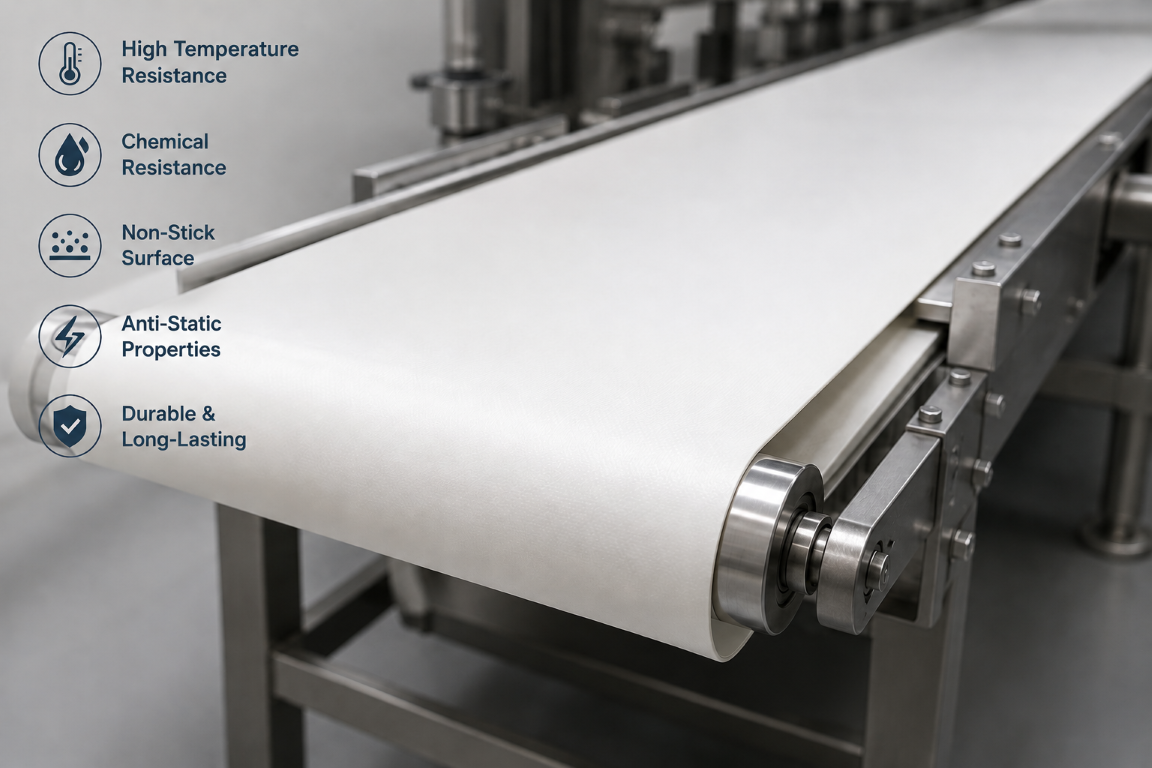
PTFE – Polytetrafluoroethylene
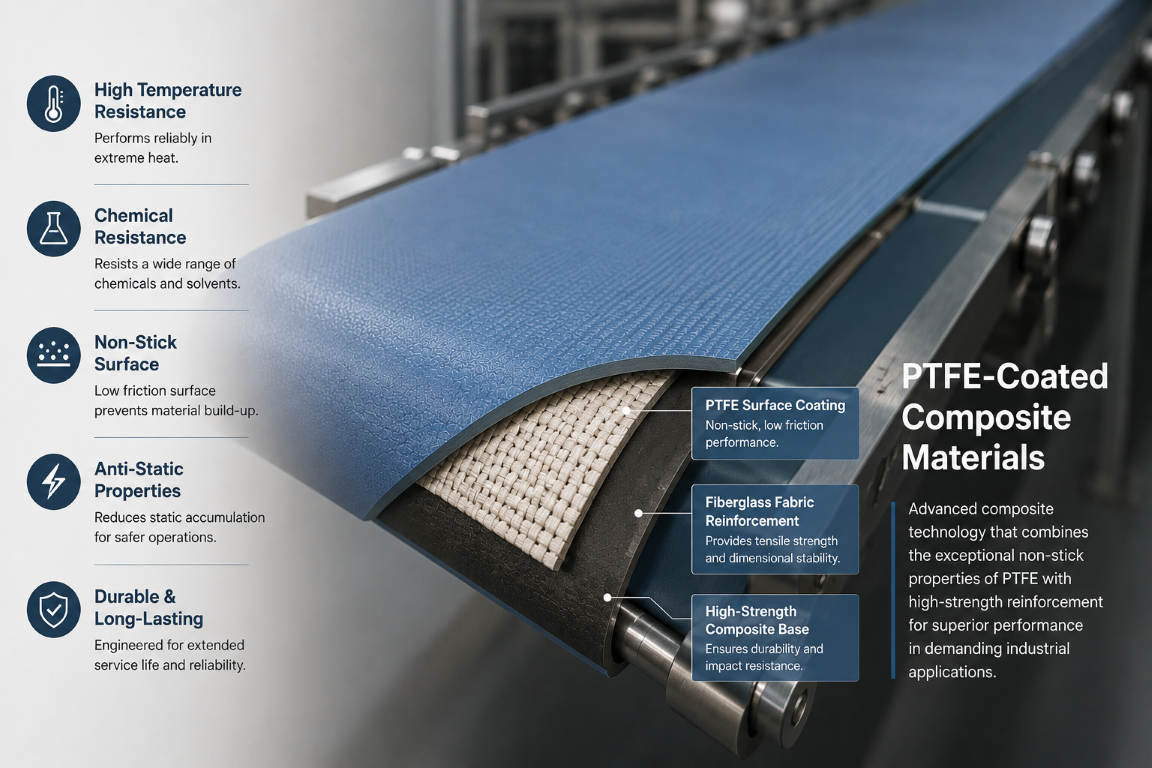
PTFE-Coated Composite Materials
PTFE itself is relatively soft and is not normally selected where high tensile strength is required. However, coating PTFE onto a woven reinforcement creates a composite material that combines the surface characteristics of PTFE with the mechanical properties of the substrate.
Typical reinforcing materials include:
- Fibreglass – excellent dimensional stability, temperature resistance and strength
- Kevlar® (aramid) – exceptional tensile strength combined with low weight
- Nomex® (aramid) – excellent thermal resistance and dimensional stability
The resulting PTFE-coated fabrics and composites can therefore provide low friction, chemical resistance and temperature resistance while retaining the strength and stability required for demanding industrial applications.
Exceptional Temperature Resistance
Typical continuous operating range: –73°C to +260°C
PTFE-coated composite materials can operate across an exceptionally broad temperature range while retaining many of their key functional characteristics.
This has led to applications ranging from aerospace and demanding industrial processes to food production and direct-contact cooking equipment.
The quoted –73°C to +260°C range refers to the continuous contact temperature of the material itself rather than simply the surrounding ambient temperature.
Certain PTFE composite constructions may tolerate temperatures outside this range for specific applications, potentially from approximately –173°C to +300°C, depending on factors including:
- Substrate construction
- PTFE coating weight
- Mechanical loading
- Exposure duration
- Operating environment
The suitability of a particular PTFE composite should therefore be assessed against the actual temperature, load and process conditions of the application.
PTFE-Coated Composite Materials
PTFE – Polytetrafluoroethylene
Polytetrafluoroethylene (PTFE), widely known by the DuPont trade name Teflon®, is a high-performance fluoropolymer composed of carbon and fluorine. It was discovered accidentally in 1938 by DuPont chemist Dr Roy Plunkett while researching new refrigerants. PTFE’s unusual molecular structure gives it an exceptional combination of thermal, chemical, electrical and non-stick properties. When PTFE is applied to high-performance woven substrates such as fibreglass, Kevlar® or Nomex®, these characteristics can be combined with excellent dimensional stability and mechanical strength.
What Makes PTFE Special?
PTFE belongs to the fluoropolymer family. Its molecular structure consists of a long carbon backbone surrounded by fluorine atoms and is commonly represented as:
(–CF₂–CF₂–)ₙ
The carbon-to-carbon bonds form the backbone of the polymer chain, while strong carbon-to-fluorine bonds surround and effectively shield that backbone. Fluorine atoms are larger than carbon atoms and form a protective sheath around the carbon chain. The exceptional strength of the carbon-fluorine bond, combined with fluorine’s low surface energy, is responsible for many of PTFE’s most valuable characteristics.
These include:
- Very low coefficient of friction
- Excellent non-stick and release properties
- Exceptional chemical resistance
- Wide operating temperature range
- Excellent electrical insulation properties
- Resistance to UV and weathering
- Low moisture absorption
- Excellent dielectric properties
- Resistance to many forms of electromagnetic radiation
Together, these properties make PTFE suitable for demanding applications where conventional plastics, elastomers and metals may be unsuitable.

UV, Infrared, RF & Microwave Performance
PTFE exhibits excellent resistance across a broad portion of the electromagnetic spectrum and is well suited to applications involving UV, infrared, radio-frequency (RF) and microwave energy.
Its combination of environmental durability and dielectric properties has resulted in the use of PTFE-coated composite fabrics in demanding aerospace and communications applications.
PTFE-coated materials can also be selected for applications such as:
- Aerospace and space environments
- RF and microwave transmission systems
- Radomes and antenna covers
- Point-to-point communications equipment
- Outdoor electrical and electronic protection
Extended exposure to intense ultraviolet radiation may cause some PTFE surfaces to undergo visible colour changes or UV bleaching without necessarily causing a corresponding loss of functional performance.
In exceptionally high-UV industrial environments, degradation of the reinforcing substrate may become the limiting factor. Where necessary, specialised PTFE coatings incorporating UV-blocking pigments or additives can be used to provide additional protection.
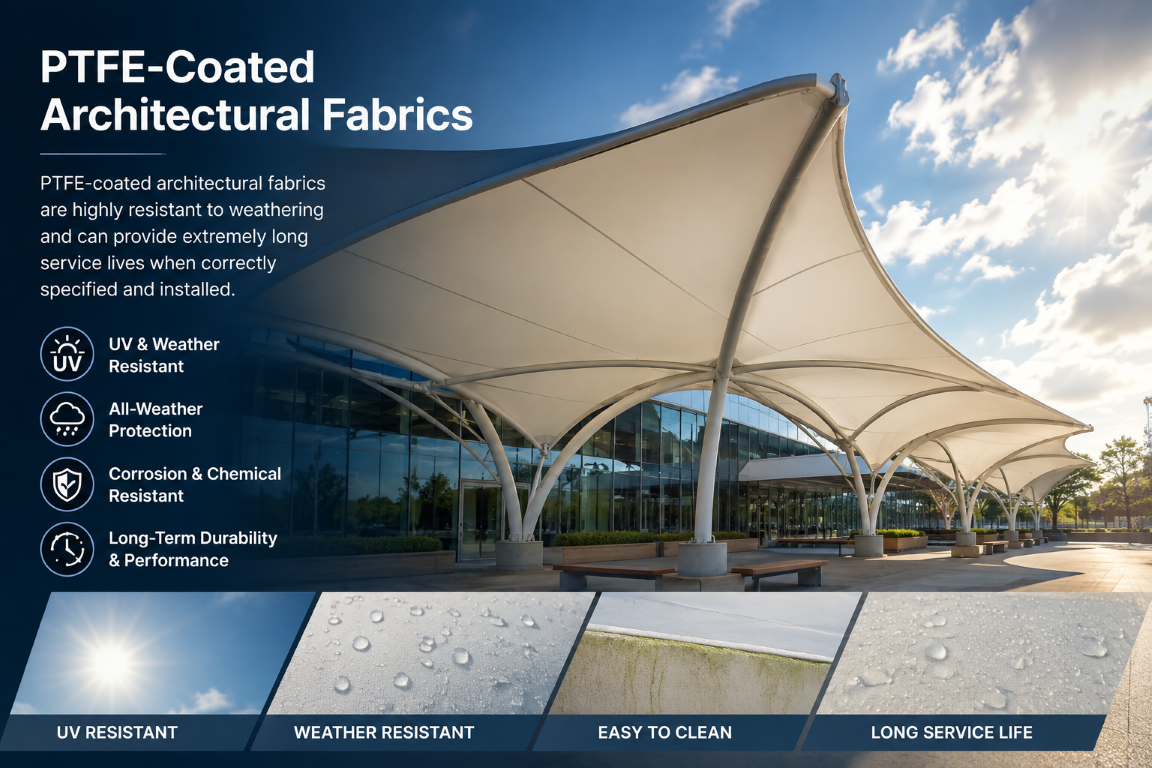
Outstanding Weather Resistance
PTFE-coated architectural fabrics are highly resistant to weathering and can provide extremely long service lives when correctly specified and installed.
The PTFE surface offers excellent resistance to:
- Sunlight and UV exposure
- Rain and moisture
- Temperature cycling
- Atmospheric contamination
- Many chemicals and pollutants
- Biological growth and environmental degradation
These characteristics have made PTFE-coated fibreglass membranes particularly important in tensile architecture and lightweight roofing structures.
Depending on the fabric construction and coating specification, PTFE architectural membranes can also provide substantial light transmission while delivering an excellent strength-to-weight ratio.
The combination of durability, low maintenance requirements, light transmission and structural efficiency enables architects and engineers to create large-span structures that would be difficult to achieve using conventional building materials.

Low Thermal Mass
PTFE-coated composite fabrics have very low thermal mass compared with conventional metal process surfaces such as steel.
This can be particularly advantageous in applications involving repeated heating and cooling because considerably less energy is required to bring the process surface to operating temperature.
In industrial baking, drying and heat-transfer processes, PTFE-coated conveyor belts can therefore offer advantages including:
- Faster heat-up and cool-down
- Reduced energy absorbed by the conveyor belt
- More efficient heat transfer to the product
- Reduced process inertia
- Potential reductions in overall energy consumption
These characteristics make PTFE-coated fabrics particularly useful in food processing, packaging, drying, curing and other temperature-controlled manufacturing processes.
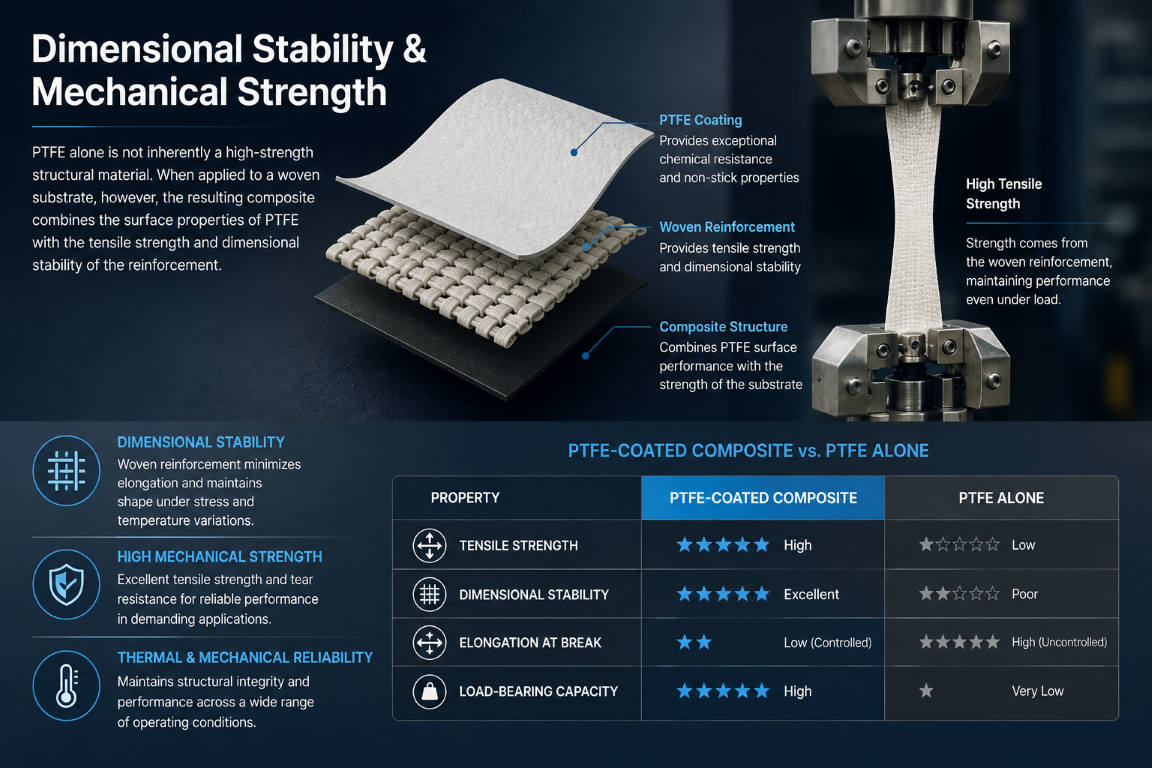
Dimensional Stability & Mechanical Strength
PTFE alone is not inherently a high-strength structural material. When applied to a woven substrate, however, the resulting composite combines the surface properties of PTFE with the tensile strength and dimensional stability of the reinforcement.
Fibreglass provides excellent dimensional stability and temperature resistance, making it one of the most widely used substrates for PTFE-coated industrial fabrics.
Kevlar® provides exceptional tensile strength at very low weight and can be selected where high mechanical performance and reduced mass are important.
Nomex® provides excellent thermal stability and is particularly valuable where elevated-temperature performance is required.
By selecting the appropriate substrate, weave and PTFE coating level, composite materials can be engineered for applications ranging from lightweight process conveyor belts and release surfaces to architectural membranes and specialist aerospace components.
Key PTFE Properties at a Glance
|
Property |
Typical PTFE Characteristic |
|
Chemical resistance |
Excellent resistance to most industrial chemicals |
|
Coefficient of friction |
Exceptionally low |
|
Surface characteristics |
Non-stick and easy release |
|
Continuous temperature range |
Typically –73°C to +260°C for coated composites* |
|
Weather resistance |
Excellent |
|
UV resistance |
Excellent |
|
Moisture absorption |
Extremely low |
|
Electrical insulation |
Excellent |
|
Dielectric properties |
Excellent |
|
RF / microwave performance |
Low-loss dielectric characteristics |
|
Thermal mass of coated fabrics |
Low compared with metal process surfaces |
|
Dimensional stability |
Determined primarily by reinforcing substrate |
|
Tensile strength |
Determined primarily by reinforcing substrate |
*Exact operating limits depend on the PTFE grade, substrate, coating construction, mechanical loading and application conditions.
Why Use PTFE-Coated Composites?
The principal advantage of a PTFE-coated composite is that it combines PTFE’s exceptional surface and environmental properties with the strength and dimensional stability of a woven reinforcement.
This combination provides engineers and designers with a versatile material capable of operating in environments involving high or low temperatures, aggressive chemicals, repeated processing, outdoor exposure and demanding mechanical conditions.
As a result, PTFE-coated composite materials are widely used across food processing, packaging, textiles, aerospace, electronics, communications, chemical processing, industrial manufacturing and architectural applications.